
Identify Who Owns an Etowah County Property
Identifying an owner works best as a sequence. One screen is rarely enough. Etowah County's open Property Search makes the best first stop, since an address query returns the county's owner entry along with stable parcel keys. The Probate Judge's deed records then supply the recorded transfer that can confirm that name.
- Search the situs address in the Etowah County Property Search and open the matching parcel card.
- Copy the PIN, parcel number, tax year, OWNER entry, and legal description.
- Check the parcel in KCS GIS so the polygon and site match the address you started with.
- Confirm the grantee and vesting on the most recent deed held by the Judge of Probate.
The result is strongest when all four points line up. A reused owner name can otherwise point to the wrong parcel. A similar street name can do the same, and so can a shared mailing address. Keep each step narrow. The assessor says which owner string sits on the assessed parcel. GIS says whether that parcel matches the land behind the address. Probate says who took the recorded interest in the latest conveyance. Read together, they answer the question. That method finds who owns an Etowah County property. It remains public-record research, though, rather than a professional title examination.
Capture the PIN Before Tracing the Etowah County Owner
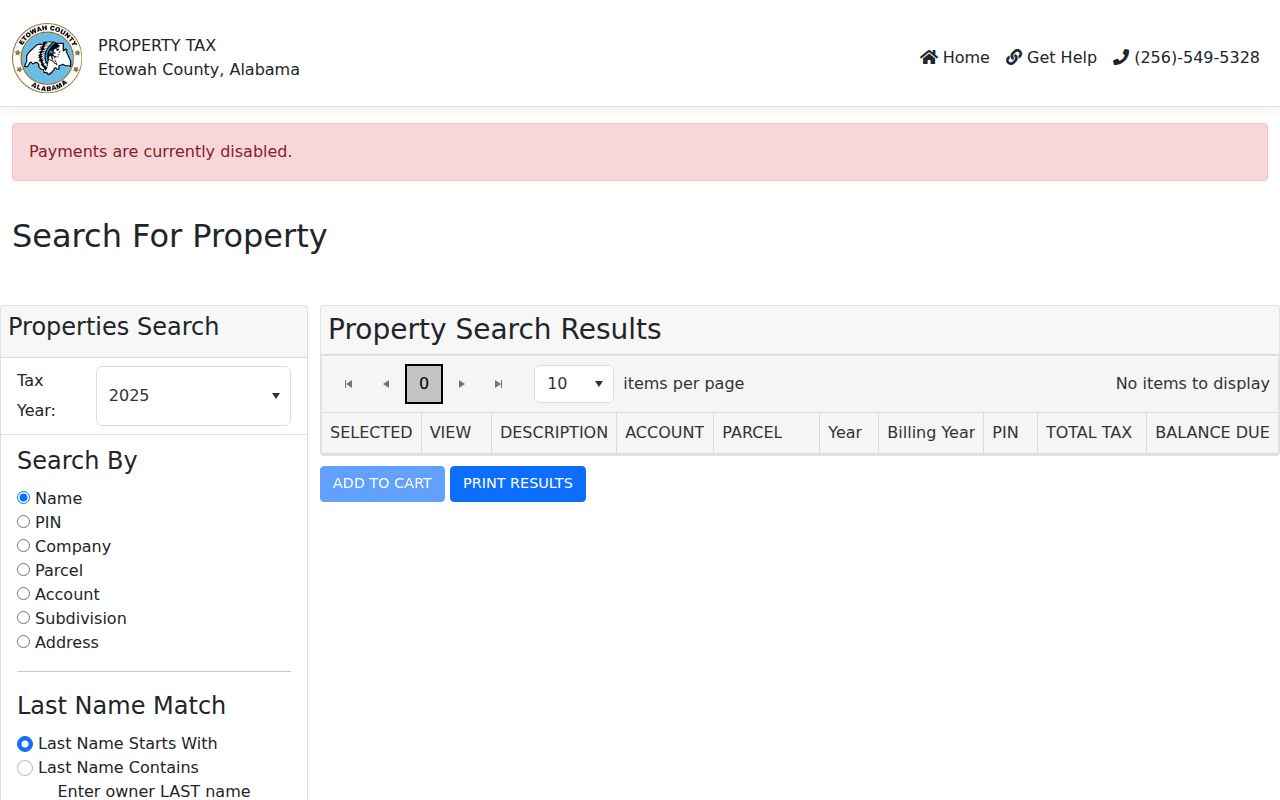
The tax system offers several search modes: Name, PIN, Company, Parcel, Account, Subdivision, and Address. Address is the convenient one. The PIN and parcel number are better. Those identifiers bridge the assessment card and the map. One address can still return real, personal, utility, and other property types mixed together, so read the property type and legal description before accepting an owner name.
The property card separates Property Address from Mailing Address. The first is the parcel's situs. The second carries tax-roll contact and may be elsewhere. Neither field alone proves who occupies the land.
If an address returns several rows, compare parcel class, acreage, legal description, and map position before choosing one. The county's 800 Forrest Avenue search illustrates the trap. One street address there carries multiple property types. A condominium, a utility account, a personal-property row, and a land parcel do not answer the same ownership question. Pick the wrong row and you may record a genuine owner name for the wrong asset.
See the OWNER Field on an Etowah County Tax Card
The public Etowah County Property Search opens without an account gate. The probate portal keeps one. Every parcel card places the exact label OWNER beside the mailing and property-address fields.
Save the tax year along with any owner entry. The card is an assessment record tied to a tax cycle, not a live title certificate.
Compare Etowah County Property Owner Sources
Every county source answers a narrower question. Read them together when the goal is to find who owns this property rather than collect a name off a single screen.
| Record source | Ownership clue | How to reach it |
|---|---|---|
| Revenue Commissioner tax roll | OWNER, mailing address, situs, parcel keys, legal description | Public AssuranceWeb Property Search |
| Judge of Probate record | Grantee and the words that vest title in the latest deed | Courthouse official record; online portal requires sign-in |
| KCS GIS | Owner label, parcel polygon, PIN, and link to tax details | Public map viewer |
| Alabama Secretary of State | Business-entity record when the owner string is a company | Public Business Entity Records Search |
The tax-roll owner may instead be an occupant, a manager, or an heir. It may also be a recent buyer. The latest deed remains the key confirmation. A full title opinion takes more than this public-record workflow. Dates matter as much as names. Write down the tax year shown by AssuranceWeb and the deed date. Note the date a GIS layer was viewed. When records conflict, the newest date does not automatically win. A freshly signed deed may not be recorded yet. The tax roll may intentionally sit on an earlier processing cycle. Ask the custodian which record controls the question being researched.
Why Etowah County May Still Show a Prior Owner
Etowah County's own timing example shows the lag. A deed signed October 31, 2024 would be worked for the 2026 tax year. The 2025 notice still went to the previous owner. A buyer wanting that notice had to request an address change. The county publishes no guaranteed recording-to-assessor update interval.
Timing check. A tax bill can retain the prior owner's name even after the deed has been recorded.
That is why the tax card alone cannot always settle who owns this property. Note the year. Then confirm the latest conveyance with the recording office.
Trace the Etowah County Name to the Latest Deed
The Judge of Probate serves as Etowah County's recorder. Deeds, mortgages, assignments, plats, judgments, liens, and lis pendens all pass through the office. The official file sits at 800 Forrest Avenue, Suite 122, in Gadsden. The county warns that online information can omit or add material, and the courthouse record controls when versions differ.
Etowah Probate AssuranceWeb demands an email and password. No grantor, grantee, book, page, or instrument fields appear before login. Coverage years stay unpublished too. That leaves two options. Use the courthouse counter, or mail the office at Judge of Probate, PO Box 187, Gadsden, AL 35902. Never assume a cutoff year the county never published.
Bring specifics to either one. Give the current owner string and the legal description, then ask for the most recent conveyance affecting that land rather than the newest document carrying a similar personal name. A mortgage or lis pendens may postdate the deed. Newer does not mean a new owner. Record the instrument type, the recording date, and the book/page or instrument identifier the office returns.
Decode Company, Trust, and Estate Owner Names
An owner string in Etowah County records can name a company. It may also name a trust, an estate, a public body, or several people. Copy the spelling exactly. Search before you assume anything about the name. An Alabama company can be checked against the Secretary of State Business Entity Records Search. That record sorts out similarly named firms. But it does not replace the deed or prove a registered agent owns the parcel.
Ownership terms in the record trail
- Owner of record
- The person or entity named in the operative public record.
- Vesting
- The deed language stating how title is held.
- Grantee
- The party receiving the interest in a recorded conveyance.
- Situs address
- The location of the parcel, distinct from the owner's mailing address.
Use Etowah County Legal Descriptions to Break Ties
Street addresses fail sometimes. A mailing address can change. It may not describe vacant land at all. Match the tax card's legal description against the deed and any plat it cites. Etowah County's historic plat page groups images from 1893 through 1977, including split year groups. Older tracts read differently. They may cite section, township, and range. They may also name a creek, a farm tract, or adjoining owners instead of a modern address.
A plat book and page can separate two lots. Those lots may share a mailing city or similar street description. GIS adds useful shape context. Still, the mapped line is not a survey, and it cannot settle a boundary dispute.
Rural tracts make the legal description the real key. Search a platted subdivision exactly as recorded, and keep the lot and block numbers. The county Mapping office and the historic plat groups help locate the cited sheet. Probate holds the recorded instrument. That instrument links the owner of record to the land in Etowah County.
Limits on Who Owns This Property Results
The public record names an owner of record. That is all it does. A life estate, probate matter, unrecorded interest, pending correction, or delayed assessment update may require more work, and the record never shows who sleeps at an address. Liens and lis pendens are separate recorded instruments, so never infer them from the OWNER field.
Lawful use. Use Etowah County owner records for legitimate property research and due diligence, never to target, intimidate, stalk, or harass a person.
Some situations demand real verification. For a purchase, estate, easement, or title dispute, verify the underlying documents with the custodian and seek qualified help when the legal effect matters.