
Separate Etowah County Property Value Types
Read the label, effective tax year, and source before comparing one figure with another.
| Value | What It Is | Where |
|---|---|---|
| Appraised value | County estimate before the class ratio | Revenue parcel card |
| Assessed value | Appraised value after the ratio | Assessment field |
| Taxable value | Roll figure after relevant treatment | Tax record |
| Sale consideration | Amount reflected in a transfer | Recorded deed trail |
Assessment figures belong to the tax roll. A deed record, by contrast, describes one past transaction between parties. Neither document promises what a parcel would fetch on the open market today.
Look Up an Etowah County Assessed Value
The Etowah County Property Search takes queries by address, owner, PIN, company, parcel, account, and subdivision.
- Search the address and choose the correct parcel.
- Record land, improvement, appraised, taxable, and assessed values.
- Note the tax year and compare value history.
- Check the deed separately for transfer consideration.
- Assessed value
- Appraised value after the statutory ratio.
- Appraised value
- The county's full-value estimate.
- Assessment ratio
- The percentage applied by property class.
Read Etowah County Land and Improvement Values
The parcel card breaks values apart before it adds them up. Land sits on one line. Improvements sit on another. The card then totals the appraised, assessed, and taxable amounts for the Etowah County property. That split often explains why a value moved. It will not capture every private renovation or physical condition affecting the parcel.
Keep the Etowah Tax Year With Every Value
Every value needs its tax year attached. The county card offers historical selections running from 1997 through 2027, plus value-history rows for tracing change. Always compare like years. A later screen may reflect annual equalization, class treatment, or a redrawn parcel rather than any sale at all.
Understand Alabama's Seven Percent Cap
Act 2024-344 and its related revenue rule limit annual increases in taxable assessed value to seven percent for Class II and III property, within the law's terms. The cap applies to taxable assessed value only. It guarantees no market price for the parcel.
Find Sale Clues in Etowah Deeds
The Judge of Probate records every deed transfer in the county. The office's online portal presents an account sign-in and no public search fields. When consideration matters, go to the courthouse official record. Keep in mind that some transfers are not ordinary market sales. Family deeds are a common example.
Do Not Let Etowah GIS Set the Price
KCS GIS supplies parcel shapes, aerial imagery, roads, water features, and city-limit lines for Etowah County. Those GIS map layers are great for confirming you have the right tract of land. They set no price. A mapped boundary calculates no market value. An overhead image stands in for no survey.
The Etowah Sample Card Makes the Split Concrete
One county-government parcel, PIN 33819, shows the structure clearly. The record lists 5.30 acres. It separates a land value of $634,900 from improvements of $12,574,800, then reports appraised and taxable value of $13,209,700 and assessed value of $2,641,940. Because a governmental property like this is not a typical residence, the amounts serve only to demonstrate how the record is organized.
The official parcel summary shows how Etowah County labels these value types.
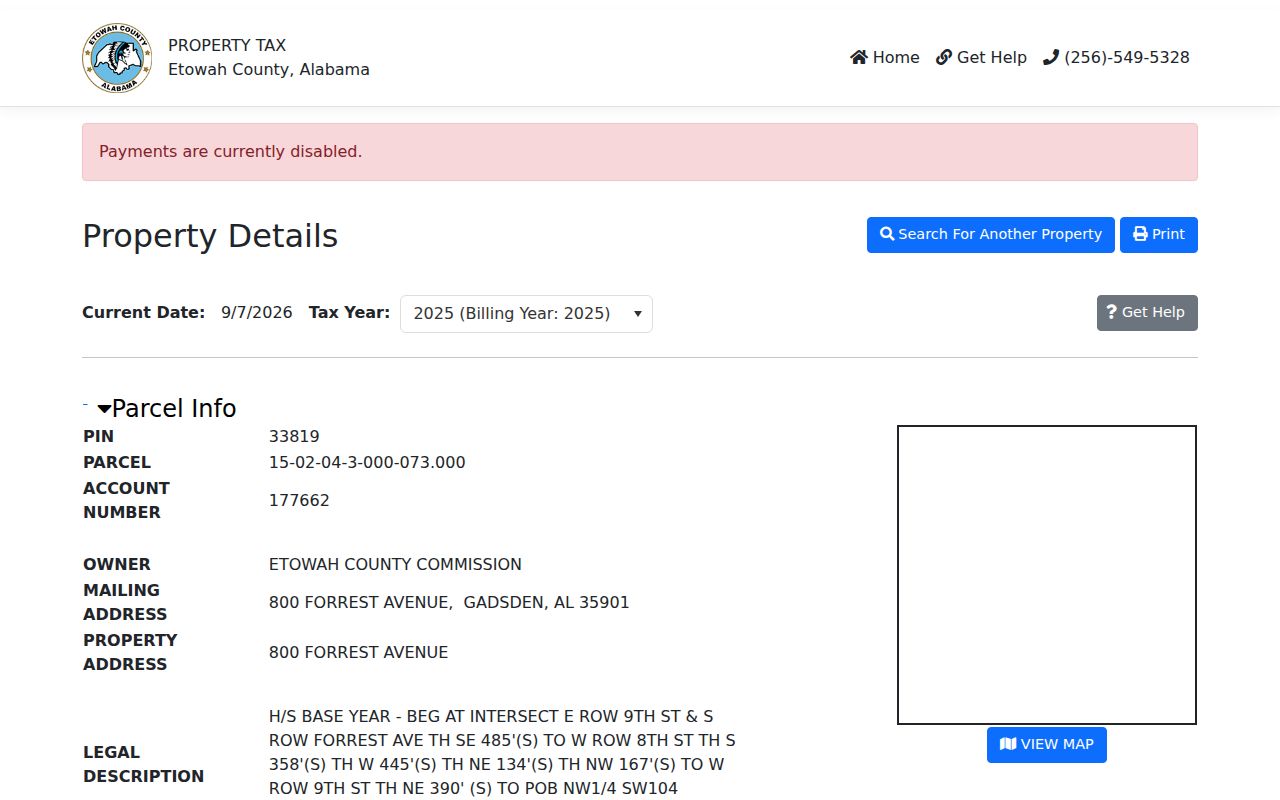
The official parcel summary is useful precisely because appraisal components and assessment figures appear side by side. It also shows the trap. Quoting the highest or lowest number without its label and tax year misstates the public record.
Annual Equalization Can Move Value Without a Sale
The Alabama Department of Revenue describes annual equalization as a review of roughly one quarter of property each year on a four-year cycle. So a new appraised figure can appear with no ownership transfer behind it. The movement may trace to updated property characteristics, neighborhood analysis, a routine review cycle, or another assessment decision. Nothing was sold.
To read a year-over-year change properly, compare land and improvements separately. Then note acreage, property class, exemptions, current-use treatment, taxable value, and assessed value for both years. Confirm the PIN and parcel describe the same tract in each. A split, combination, correction, or added improvement can quietly break a simple percentage comparison.
Equalization is why assessment history is not a sales ledger. The deed records answer whether a transfer was ever recorded. The parcel card answers how the county valued the property for one tax cycle.
Read the Seven-Percent Limit at the Correct Level
Alabama's 7 percent cap guidance covers annual increases in taxable assessed value for qualifying Class II and III property. It uses the statutory base-year framework and its exceptions. It does not freeze appraised value. It guarantees no sale price. And it does not mean every line on an Etowah parcel card is limited to a seven percent climb.
When comparing years, calculate changes on the labeled taxable assessed figure. Applying the cap casually to land, improvements, or an appraised total will mislead. A transfer, new construction, classification change, omitted property, or another statutory event can shift how the rule operates. So the state guidance and the parcel's own history both belong in the picture.
The cap is one explanation for how tax-year numbers relate. It is not a valuation method. It cannot estimate present market value. Nor can it reverse-engineer what a willing buyer might pay for Etowah County real estate.
Current Use and Exemptions Change Taxable Meaning
Current-use treatment and exemptions can pull taxable or assessed figures far from the appraised amount. The property itself stays exactly the same. Alabama's current-use guidance spells out an application window, reapplication rules, and rollback consequences. Those consequences apply when the use changes. A specially treated figure should never be presented as an ordinary market estimate.
Read the exemption or use indicators for the tax year you selected. Do not project them onto a different owner of record or a future year. Qualification is an assessment matter governed by the rules and the parcel's own facts. An exemption, likewise, never reduces the consideration written into a deed. It also never describes a building's condition.
A useful worksheet keeps appraised, taxable, and assessed values in separate columns. It then adds class, exemption status, current-use status, and year. Two apparently similar Etowah County parcels can then carry very different taxable figures. The reason is visible without either one being worth less on the open market.
Know What Etowah County Property Value Cannot Prove
No assessment captures every condition a buyer or appraiser would examine. A past sale can be old, partial, unusual, or between family members. Etowah County's sample card breaks value into separate land, improvement, total appraised, taxable, and assessed fields, so a single number copied without its label can misstate the record. Read the field name before trusting the figure.
Value vs price. Assessed value is a tax-roll figure, not a promised sale price and not a private appraisal.
Assessed and taxable value can move even without a new deed. Annual equalization changes the tax roll on its own. Current-use treatment, exemptions, property class, and the statutory ratio can each pull the assessed figure away from the full appraised amount, which explains the number but predicts nothing about a buyer's offer.
Keep a dated worksheet for every value question. Record the PIN, tax year, land value, improvement value, appraised total, taxable amount, and assessed amount. When comparing years, confirm that parcel identity and acreage stayed constant, because a split, a combination, a new improvement, or a classification change can quietly break a simple year-to-year comparison.
A recorded deed needs context too. Confirm the deed covers the same estate and the same tract. Do not assume every transfer reflects an arm's-length sale. For decisions that turn on present market value, rely on current property facts and qualified valuation work rather than a tax card or an old transfer alone.
Dates matter as much as amounts. Save the AssuranceWeb tax year and retrieval date, the deed's execution and recording dates, and the effective date of any private appraisal. A comparison that mixes a prior assessment, a later deed, and present physical conditions can look precise while describing three different moments in time.
Treat property characteristics with the same discipline. Etowah County records list building details like year built, structure code, living area, stories, and improvement features. Those fields help explain an assessment component. Verify them when a value decision depends on condition or size, since a database description never replaces inspection.
Keep value questions separate from ownership and boundaries. The owner of record can lag behind a deed, and the GIS polygon is expressly for tax and reference use, yet neither discrepancy automatically makes the value wrong. Match the parcel first. Identify the type of value second. Only then compare amounts drawn from equivalent dates and sources.