
Fields Inside Etowah County Property Tax Records
The Revenue Commissioner property search puts parcel identity, valuation, and tax history in one place. It reports land value, improvements, appraised value, taxable value, and assessed value separately instead of collapsing everything into a single all-purpose price.
| Field | Meaning | Record location |
|---|---|---|
| Land and improvements | Separate appraisal components | Parcel card |
| Appraised value | County appraisal before class ratio | Assessment fields |
| Assessed value | Value after Alabama class ratio | Assessment fields |
| Exemption and taxable value | Adjustments for the selected year | Tax card |
| Total, paid, and balance | Billing and payment status | Tax history |
A recorded sale price belongs to the deed trail, not the tax roll. Appraised and assessed values drive the tax system, and the bill itself applies the tax math, so none of these Etowah County figures can stand in for another.
The Etowah Sample Shows Five Distinct Values
One government parcel, PIN 33819, shows the county's vocabulary at work. The card lists land at $634,900 and improvements at $12,574,800. Appraised and taxable value sit at $13,209,700. Assessed value comes to $2,641,940. It is an inspected public property, not a typical Etowah County home. Still, the official sample card displays all five fields side by side.
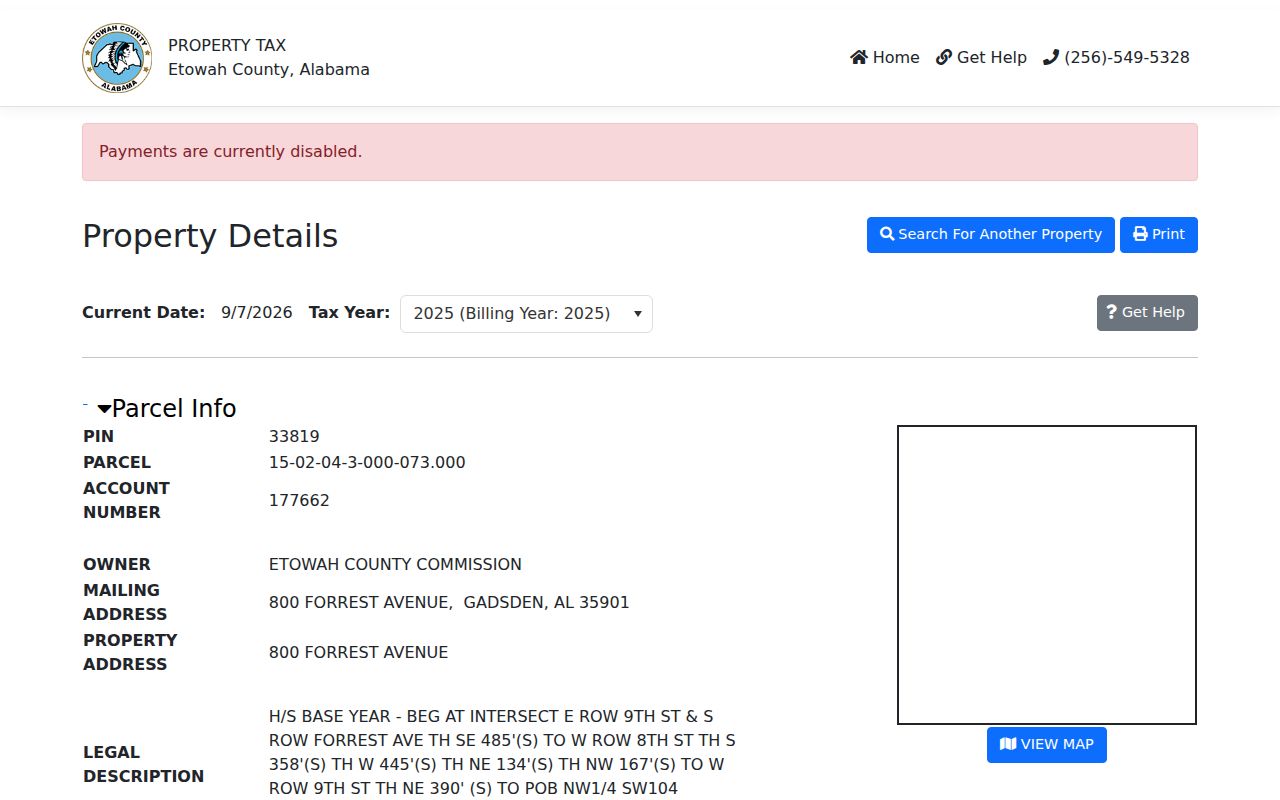
The sample card gives assessed and appraised value their own labels. Neither one is automatically what the property sold for.
October and January Control Etowah Tax Status
The county Tax FAQ sets the calendar. Etowah County taxes are due October 1 and turn delinquent January 1. Match total tax, amount paid, and balance due to the same billing year. Match the due date too, before drawing any conclusion. The county also notes that anyone may pay another owner's taxes. Payment confers no ownership. A zero balance is not a deed.
Look Up an Etowah County Tax Bill
AssuranceWeb offers several ways into the tax roll. Name, PIN, Company, Parcel, Account, Subdivision, and Address modes all appear, plus a tax-year selector. Address mode needs a street number and street address, while Name mode takes a last name with an optional first name and starts-with or contains matching.
- Search the exact street number and street name.
- Select the real-property row and verify parcel, PIN, account, and owner.
- Choose the required tax year rather than relying on the default.
- Read billing year, total, paid amount, balance, and due date together.
- Print the result and contact Collections for an official payment answer.
- Assessed value
- Appraised value after the applicable class ratio.
- Mill or levy
- A tax-rate expression in the tax calculation.
- Homestead exemption
- A benefit requiring local eligibility and application.
- Tax lien
- A statutory claim arising from unpaid tax.
An Etowah Deed Can Reach a Later Tax Year
Timing explains a lot of confusion in Etowah County tax records. The county's ownership and mapping guide gives a concrete example: an October 31, 2024 deed gets worked for tax year 2026. The 2025 notice still goes to the prior owner. That is why a tax bill can carry an earlier name long after closing. Check the year on the notice. Then confirm ownership through the newest deed in the recorder's records.
Annual Equalization Meets the Seven-Percent Cap
Alabama's annual equalization reviews roughly a quarter of property each year on a four-year cycle. Act 2024-344 added a separate 7 percent cap on yearly increases in taxable assessed value. State rules and exceptions shape how that cap works. Read the Department of Revenue cap guidance before assuming the cap covers every change. It may not cover every value component either.
Etowah Delinquency Can Reach a Tax-Lien Auction
Unpaid Etowah County taxes can end at a tax-lien auction. The Collections page covers payment options and tax-sale information. A dated county notice scheduled the 2025 GovEase auction for May 1. It also listed registration and pre-bidding dates. That notice documents one year's process, not a fixed annual calendar. The Tax FAQ also describes a three-year redemption period. Get current parcel-specific instructions before relying on any sale record.
Note: A tax-lien auction and deed transfer are different events, and paying another owner's bill does not create title.
Exemptions and Current Use Change Taxable Value
Exemptions and current-use treatment can move taxable value without touching the parcel itself. Check which exemption code sits on the selected year's card. Then ask the Revenue Commissioner about eligibility and filing rather than guessing. Alabama's current-use guidance spells out the application window, reapplication, and rollback consequences, and a prior owner's tax history says nothing about your eligibility.
Challenge an Etowah County Assessment
An Etowah County owner who disagrees with a value has a short window. Alabama guidance requires a written protest to the County Board of Equalization. It must arrive within 30 calendar days of notice. A strong file can include the parcel card, photographs, comparable sales, and an appraisal. It should also show an error in land, improvement, classification, or exemption data. Appeals from a final assessment may face a separate 60-day deadline. The state protest guidance walks through the protest process.
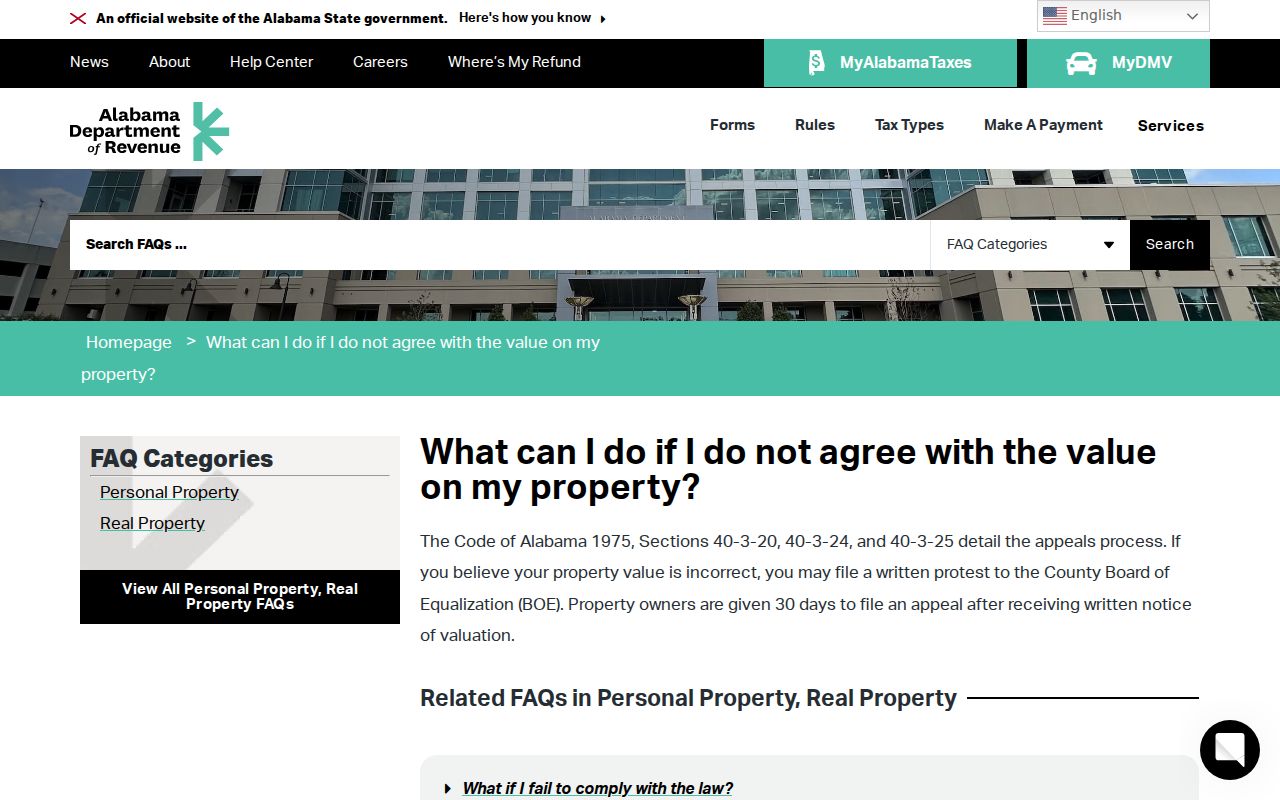
The state guidance makes the notice date the trigger for that short action period. Confirm the exact Etowah County filing destination and deadline before mailing anything.
Appeal window. A Board of Equalization protest generally must be written and filed within 30 calendar days of the valuation notice.
Tax history is evidence of billing, not ownership.
AssuranceWeb can show historical tax years, prior amounts, and payment data. It can also show the owner strings tied to each yearly record. That history helps reconstruct when an assessment changed or a balance appeared. It is not a deed chain. Processing timing can keep a former owner's name on a parcel after closing. A third party's payment never creates ownership. Only the Probate deed records establish the owner of record.
Compare years carefully. Record land, improvement, appraised, taxable, and assessed values separately for each one. A change may trace to new construction, an equalization review, classification, or an exemption. It could also come from current-use treatment or another parcel-specific event. Ask the Revenue Commissioner for the reason instead of reading it into the numbers.
Separate the Revenue Commissioner from Collections.
The Revenue Commissioner handles appraisal, assessment, mapping, and the property search. Collections takes payment and delinquency questions. A value correction starts with assessment staff. A posted payment, balance, redemption, or tax-sale question belongs with Collections. Deeds and other land instruments stay with the Judge of Probate as recorder.
| Question | Etowah source | Bring with you |
|---|---|---|
| Parcel value or exemption | Revenue Commissioner | PIN, parcel, tax year, notice |
| Payment or delinquency | Collections | Account, parcel, billing year |
| Assessment protest | Board of Equalization process | Notice and supporting value evidence |
| Ownership transfer | Judge of Probate | Names, legal description, recording reference |
This office split keeps roles straight. It stops a tax lookup from becoming an ownership conclusion, or a deed request from landing on the payment desk.
Preserve an Etowah tax search for later review. A reproducible file deserves care. Include the search key, the tax year, the retrieval date, and the owner string. Add the situs and mailing addresses, the PIN, the parcel number, and the account. Value fields, exemptions, tax district, total tax, payment, and balance complete the record. Print Results sits on the result interface. Save the notice and any correspondence separately when the parcel is under appeal or involved in a sale, since the live portal can change after processing.
Keep each source in its lane. The GIS map confirms geographic context only. Its polygon and imagery do not set appraised value. The recorded deed traces the transfer trail. Keeping those roles distinct makes an Etowah County property tax record easier to explain and challenge.
Read Land and Improvements as Separate Evidence
The Etowah parcel card splits land value from improvement value. Behind the improvement total, it can expose building-detail fields. One courthouse parcel shows year built, structure code, living area, and building value. It also lists stories and improvement features. That level of detail is unusual for a government parcel. Treat it as a field inventory, not a model for a house.
Name the component that looks wrong before questioning value. A land issue may involve parcel size, location, or classification. An improvement issue may involve dimensions, condition, age, or a structure that has changed. Compare the current card against photographs, permits, an appraisal, and comparable evidence. Then present the specific discrepancy within the protest deadline.
The Tax-Year Selector Changes the Etowah Answer
One Etowah detail record offers tax-year choices from 1997 through 2027. The search interface defaults to its current working year. That span on a single parcel does not promise identical history for every parcel. Pick the needed year before comparing owners, exemptions, tax district, or value. Note whether the displayed year is a tax year or a billing year.
Year-by-year differences work best when each field is tracked consistently. A table can list land, improvements, appraised, taxable, assessed, exemption, total tax, paid amount, and balance. That stops a change in one category from being misread as a change across all of them. Ask the county about unexplained gaps rather than interpolating missing values.
Current-Use Treatment Has Future Consequences
Alabama's current-use program values qualifying property through a special statutory method. Its guidance covers the filing window, reapplication, and rollback when use changes. A lower taxable figure under current use is not the parcel's sale price. It is also not an ordinary market appraisal. Confirm the classification and application status for the selected Etowah tax year.
Ask about rollback consequences before relying on the displayed bill when a change in use is contemplated. The record shows how the parcel was treated for that cycle. It cannot promise future qualification. Keep current-use questions with assessment staff and payment questions with Collections.
Compare the revised card with the earlier printout field by field once a correction posts. Retain the notice, submission, receipt, and county response so the reason and the effective tax year stay clear.